The Storm ⛈️
The Fearful-Avoidant Push-Pull love type
What is The Storm?
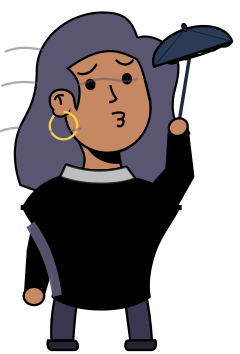
You love in extremes — the highs are electric, the lows are thunder. You want closeness and it terrifies you, so you pull people in and push them away, sometimes in the same night. It's intense, passionate, exhausting. Under the weather is someone who wants to be held and can't quite believe it's safe.
In our system that's disorganized attachment crossed with a physical-touch love language. The touch axis is why your version of the push-pull runs so hot: the reaching is physical and so is the rupture, which is why your relationships feel less like arguments and more like weather.
The part worth holding onto: the pull toward people is as real as the push away. It isn't a game, and it isn't manipulation. Two true things are firing at once and the body picks one at random.
How rare is The Storm?
On our starting estimate, The Storm is about 1% of people — the rarest of the twelve types. Roughly 99% of people land in a type that's more common than yours.
Disorganized attachment is the least common of the four patterns, and physical touch is the least commonly reported primary love language. The intersection of the two is the smallest cell in the table.
Where this number comes from, honestly. Starting estimate, seeded from published attachment-style prevalence research. It is not a count of our test-takers, and the live counter replaces it once enough tests are complete. We'd rather show you a labelled estimate than a precise-looking number we haven't earned. How we compute rarity →
What The Storm is good at
- Passionate and deeply feeling. You're not capable of doing this halfway, and people know it.
- Unforgettable. When you're in, you're all in, with a physical intensity few can match.
- Honest about the hard stuff. You don't pretend a relationship is fine when it isn't.
The pattern to watch
The come-here-go-away cycle that whiplashes partners — reaching for closeness, then torching it when it feels too real. The work is slowing the swing before it breaks the connection. A grounding ritual you can run in under a minute — breath, break, return — is the single highest-leverage skill available to you, and it's boring on purpose.
How The Storm argues
You oscillate between confronting hard and shutting down cold, often inside one conversation. The swing itself does more damage than anything either of you actually said.
- You go from zero to the centre of the issue in seconds.
- Then the shutdown arrives, and it's as total as the confrontation was loud.
- Things get said at peak intensity that take weeks to walk back.
- The ritual matters more than the words: agree on a signal, take the break, and come back at a time you named before the fight started.
Conflict style on the test: competing, then shutting down.
The Storm's love language
Storms most often give and receive love through physical touch.
Closeness and rupture both play out in the body, which is why a good night with you is extraordinary and a bad one is physically hard to be near. Touch will regulate you faster than any conversation — including the ones you needed to have — so it's worth being deliberate about which job it's doing.
Who does The Storm match with?
Fit here is qualitative, not a score. We don't publish compatibility numbers we haven't measured — when the pairing data exists, this table gets scores and a sample size.
| Pairing | Fit | Why |
|---|---|---|
| ⚓ The Anchor | Green | The steadier the partner, the calmer your weather. Same first language, opposite temperature. Full pairing → |
| 🗼 The Lighthouse | Amber | They can hold the line, but watch for them over-functioning until they're depleted. Full pairing → |
| 🌱 The Gardener | Amber | Reliable and calm. They may under-react to the highs in a way that reads as indifference. Full pairing → |
| 🎆 The Firework | Harder | Two intensities feed the storm. Spectacular for a month, unsustainable after. Full pairing → |
| 🦎 The Chameleon | Harder | Two disorganized patterns in one room, with nobody holding steady. Full pairing → |
Harder is not doomed. Every difficult pairing on this list works when both people can name the dynamic out loud — that naming is most of what the paid report teaches.
What's in the The Storm report
The long version — $29
- Your exact position on all four axes, not just the type name.
- Your triggers, and a de-escalation protocol built for The Storm specifically.
- The full 12-type compatibility table from your side.
- Communication scripts you can use verbatim.
- A 30-day plan aimed at the one habit that moves this pattern most.
Frequently asked questions
Is The Storm the same as a push-pull relationship?
The Storm is the pattern in one person that produces the push-pull. The dynamic itself takes two, and it shows up most often when this type pairs with an intense partner. Our name for the type is The Storm; the underlying pattern is usually called disorganized or fearful-avoidant attachment.
Why do I sabotage relationships when they're going well?
Because going well is precisely when the fear activates. Closeness is the thing you want and the thing your nervous system flags as risky, so the moment it arrives, both signals fire. Recognising that the fear is a false alarm doesn't switch it off, but it does buy you the pause.
Is this a clinical diagnosis?
No. Love Blueprint is a self-discovery and entertainment tool based on popular relationship frameworks. It is not a psychological assessment or medical advice.
How was the 1% figure calculated?
It's a starting estimate, seeded from published attachment-style prevalence research and split across the three love-language buckets. It is not a measurement of our test-takers yet. Once enough people have completed the test, the live counter replaces it.