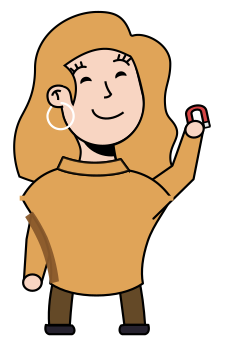
The Magnet 🧲
The Anxious-Giver love type
What is The Magnet?
When you fall, you give. You anticipate needs, over-deliver, make yourself indispensable — because somewhere underneath, staying useful feels like staying safe. You pull people in hard. The trick is trusting they'd stay even if you did less.
In our system that's anxious attachment crossed with a provider love language: acts of service and gifts. It looks like generosity and it is generosity, but there's a second thing running underneath it. Generosity with no strings feels free. Yours has an invoice you'd never send and can still feel the weight of.
The clue is the resentment. It shows up in the gap between what you gave and what came back, and it surprises you every time, because you told yourself you didn't want anything for it.
How rare is The Magnet?
On our starting estimate, The Magnet is about 7.8% of people — the 7th most common of the twelve types. Roughly 79% of people land in a type that's more common than yours.
Anxious attachment runs at roughly one in five in published research, and acts of service is a very commonly reported love language, so this combination sits close to the middle of the table.
Where this number comes from, honestly. Starting estimate, seeded from published attachment-style prevalence research. It is not a count of our test-takers, and the live counter replaces it once enough tests are complete. We'd rather show you a labelled estimate than a precise-looking number we haven't earned. How we compute rarity →
What The Magnet is good at
- Generous, attentive, devoted. You notice what people need before they've said it.
- You make partners feel deeply taken care of. Being loved by you is materially easier than being loved by most people.
- You show up in the practical crisis. The 2am airport run, the paperwork, the thing nobody else wanted to handle.
The pattern to watch
Over-giving to earn love, then feeling resentful or panicky when it isn't matched. Love isn't a debt you have to keep prepaying, and the ledger you're keeping is one your partner can't see and never agreed to. The experiment that actually moves this: do less on purpose, once, and watch what happens. Usually nothing happens. That's the point.
How The Magnet argues
You accommodate and self-abandon to avoid rupture. "It's fine" arrives fast, the hurt gets filed rather than fixed, and it leaks out later in a fight that appears to be about something else entirely.
- You'll concede almost anything to stop the temperature rising.
- The concession isn't free — it goes on the ledger, and the ledger eventually gets read out.
- You apologise early, sometimes for things that weren't yours.
- Your growth edge is a plain sentence: "here's what I need." No preamble, no earning it first.
Conflict style on the test: accommodating.
The Magnet's love language
Magnets most often give and receive love through acts of service and gifts.
Doing is how devotion comes out of you. What complicates it is that you're also hoping it comes back the same way, and a partner who says thank you warmly but never reciprocates in kind will leave you feeling unseen while genuinely believing they've been appreciative.
Who does The Magnet match with?
Fit here is qualitative, not a score. We don't publish compatibility numbers we haven't measured — when the pairing data exists, this table gets scores and a sample size.
| Pairing | Fit | Why |
|---|---|---|
| 🌱 The Gardener | Green | They give back in the same language without needing you to earn it, which breaks the loop. Full pairing → |
| 🗼 The Lighthouse | Green | They'll name what's happening out loud, including the over-giving, without making it a criticism. Full pairing → |
| ⚓ The Anchor | Green | Steady and affectionate. Nothing has to be bought. Full pairing → |
| 🏰 The Fortress | Harder | Two providers, opposite directions: you give to get close, they give to stay at arm's length. Full pairing → |
| 🌉 The Drawbridge | Harder | The more they pull back, the more you give. Anxious-avoidant, in its most exhausting form. Full pairing → |
Harder is not doomed. Every difficult pairing on this list works when both people can name the dynamic out loud — that naming is most of what the paid report teaches.
What's in the The Magnet report
The long version — $29
- Your exact position on all four axes, not just the type name.
- Your triggers, and a de-escalation protocol built for The Magnet specifically.
- The full 12-type compatibility table from your side.
- Communication scripts you can use verbatim.
- A 30-day plan aimed at the one habit that moves this pattern most.
Frequently asked questions
Is The Magnet the same as people-pleasing?
There's overlap, but they're not the same thing. People-pleasing is a behaviour; The Magnet is that behaviour attached to a specific pattern — anxious attachment plus an acts-of-service love language. The giving is genuine. It's the condition underneath it that's worth looking at.
Why do I feel resentful when I chose to give?
Because part of it wasn't a choice. Giving that comes with an unspoken hope of being matched isn't a gift, it's an exchange the other person didn't know they'd entered. Naming what you want directly removes the trap for both of you.
Is this a clinical diagnosis?
No. Love Blueprint is a self-discovery and entertainment tool based on popular relationship frameworks. It is not a psychological assessment or medical advice.
How was the 7.8% figure calculated?
It's a starting estimate, seeded from published attachment-style prevalence research and split across the three love-language buckets. It is not a measurement of our test-takers yet. Once enough people have completed the test, the live counter replaces it.